
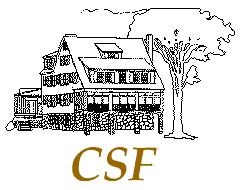
Computer Security Foundations SymposiumThe Computer Security Foundations Symposium is an annual conference for researchers in computer security, to examine current theories of security, the formal models that provide a context for those theories, and techniques for verifying security. It was created in 1988 as a workshop of the IEEE Computer Society Technical Committee on Security and Privacy, in response to a 1986 essay by Don Good entitled "The Foundations of Computer Security - We Need Some." The meeting became a "symposium" in 2007, along with a policy for open, increased attendance. The atmosphere of the symposium is informal, often in a peaceful, rural setting that encourages an exchange of thoughtful technical discussion by all attendees, both during and after scheduled presentations. It was held for seven years at the Franconia Inn, Franconia, New Hampshire, USA (pictured above), and subsequently at various European and North American locations. The program includes papers and panels. Topics of interest include access control, information flow, covert channels, secure protocols, database security, language-based security, authorization and trust, verification techniques, integrity and availability models, and broad discussions concerning the role of formal methods in computer security and the nature of foundational research in this area. The symposium program is chosen from among submissions by prospective participants. The next symposium, CSF-21, will be in Pittsburgh, PA, June 23-25, 2008. CSF-21 will be collocated with the 23rd IEEE Symposium on Logic in Computer Science (LICS), at Carnegie Mellon University.
Proceedings of later workshops (1993, No. 6; and 1997-2005, 10-18)
or a photocopy of individual papers in the remaining proceedings,
can be provided by the
publications chair
on request.
Articles from 1995 and later can be downloaded from the IEEE Computer Society
Digital Library.
The Charter of the Computer Security Foundations Workshop outlines its organization. |